
In this blog Dr Sofia Collignon analyses the data from 2019 and shares her conclusions.
When the General Election was called in November 2019 around 20 women from different parties, among them Heidi Allen, Amber Rudd, Nicky Morgan, Seema Kennedy, Dame Caroline Spelman, Dame Louise Ellmann and Gloria De Piero, decided to step down and not to seek re-election. They cited the daily abuse, harassment and intimidation they receive as the reason for this. This confirmed what we’ve long suspected, that the aggressiveness of the political environment is undermining efforts to get more women into parliament. We are awaiting research from the Fawcett Society which looks specifically at the issues around retention of women MPs.
Despite this, a record number of women stood for office – 37% of candidates were female. This was up 8% from 2017 (29%) and 11% from 2015 (26%) showing an ongoing positive trajectory. But, there were significant variations across the parties. Labour was the first party in UK history to stand more female (53%) than male (47%) candidates. The Liberal Democrats increased the proportion of women by 29 percentage points to reach 31% of the total. The Conservative party only increased the number of female candidates they stood by 1%, up to 31%. These variations may reflect differences in the demographic composition of the party membership, but most likely, they reflect the differences in party attitudes towards gender equality and commitment to implement actions that actively encourage women to become candidates.
Parties have to be serious about increasing the number of female candidates, not just to improve representation but for the many reasons Helen Pankhust sets out in her blog. Although a record number of women became MPs (220/34%) this important achievement has two caveats. Firstly, women and girls made up 51% of the population in the UK meaning we are still 14% away from parity. Secondly, is the distribution of seats. For the first time in history, more than half of one party’s seats are women as 51% of Labour MPs are female. Indeed, despite the size of the Tory majority, only 40% of the elected women are in government with the rest in opposition.
There are two ways to increase the proportion of women in the House of Commons. Either they win a seat from a male incumbent or they win one that has been left vacant because the MP did not seek re-election. The analysis of the seats that changed hands between women and men after the 2019 GE indicates that both sexes are equally likely to challenge and win from an incumbent. Yet, women are significantly more likely to win a seat that has been left vacant. 68% of women stepping down were replaced by other women and 56% of men were replaced by other men. 44% of male MPs were replaced by women. With senior women such as Harriet Harman already announcing they are standing down at the next election it will be interesting to see how many retirement seats select women candidates and what impact this has on the number of women elected.
With regard to the issue of abuse towards women in politics, survey-based data suggests that during the 2017 GE campaign, 37% of candidates suffered from abuse, harassment or intimidation and that these actions targeted women. Around one in two women competing for a seat suffered at least one form of abuse. After controlling for incumbency, ethnicity, party and age, the data shows women are on average, 8% more likely to suffer abuse than men.
This did not improve in 2019. In 2019, 49% of candidates indicated that they had suffered from any form of abuse, harassment and intimidation (HAI) while campaigning, this is an increase of 11 percentage points compared with 2017. The rate at which abuse is increasing is worse for women. In 2017, 45% of women respondents to the survey reported experience of some form of harassment, abuse or intimidation whilst campaigning compared with 35% of men. By 2019 a sizeable majority of women reported experiencing harassment, abuse or intimidation (58%). So, what may we expect in the next election?
Although harassment and intimidation towards women doesn’t seem to have decreased the number of women participating in politics in the UK, research and anecdotal evidence show that they are more likely to be targeted during campaigns and that the abuse does not stop once they become MPs. Recent research by the BBC has revealed the extent of abuse MPs receive online, with female MPs including Jess Philips, Charlotte Nicols and Anna McMorrin speaking out about their experiences. This harassment has an effect on the length of their careers and their quality of life while in office, most likely affecting substantive representation and the building of female legislative expertise.
All the parties need to consider how to respond to this harassment and to protect women who take part in public life. And they all need to consider how best to ensure they have enough women candidates to get a fairer representation of women in parliament.
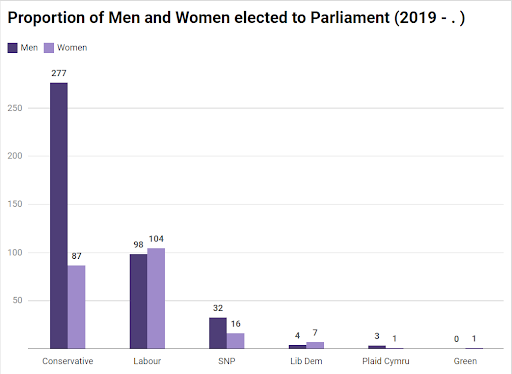
Both graphs from the Representative Audit of Britain 2019.
Dr Sofia Collignon is an expert in the study of candidates, elections and parties and gendered violence against political elites.