
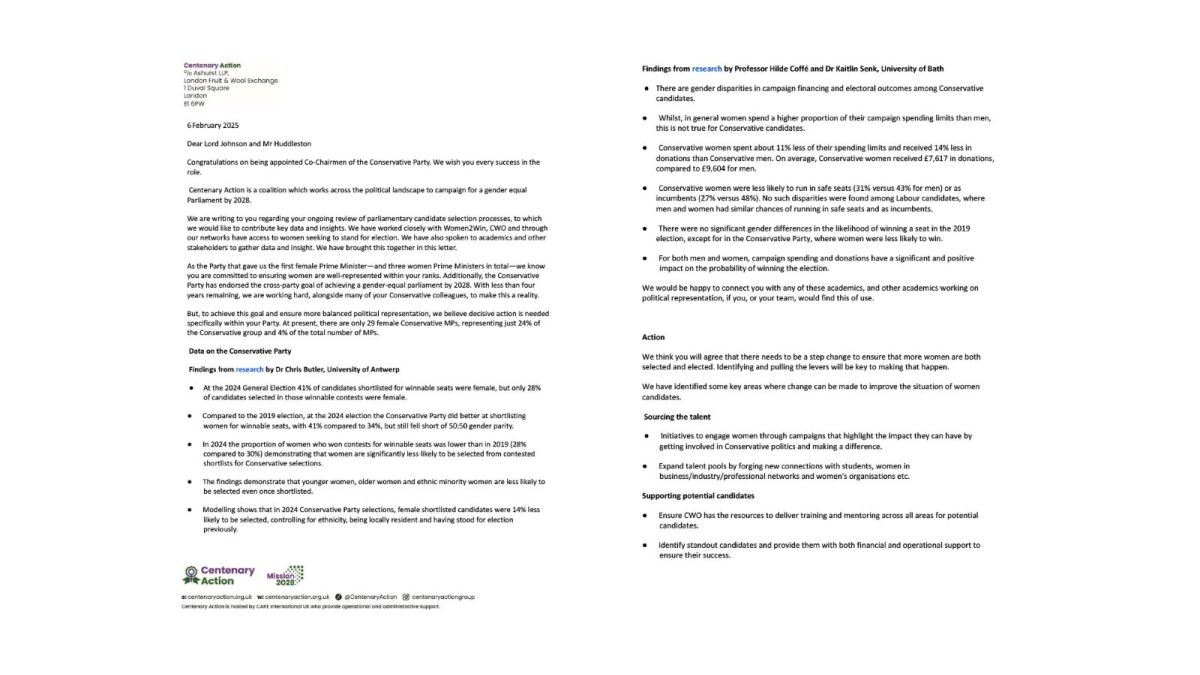
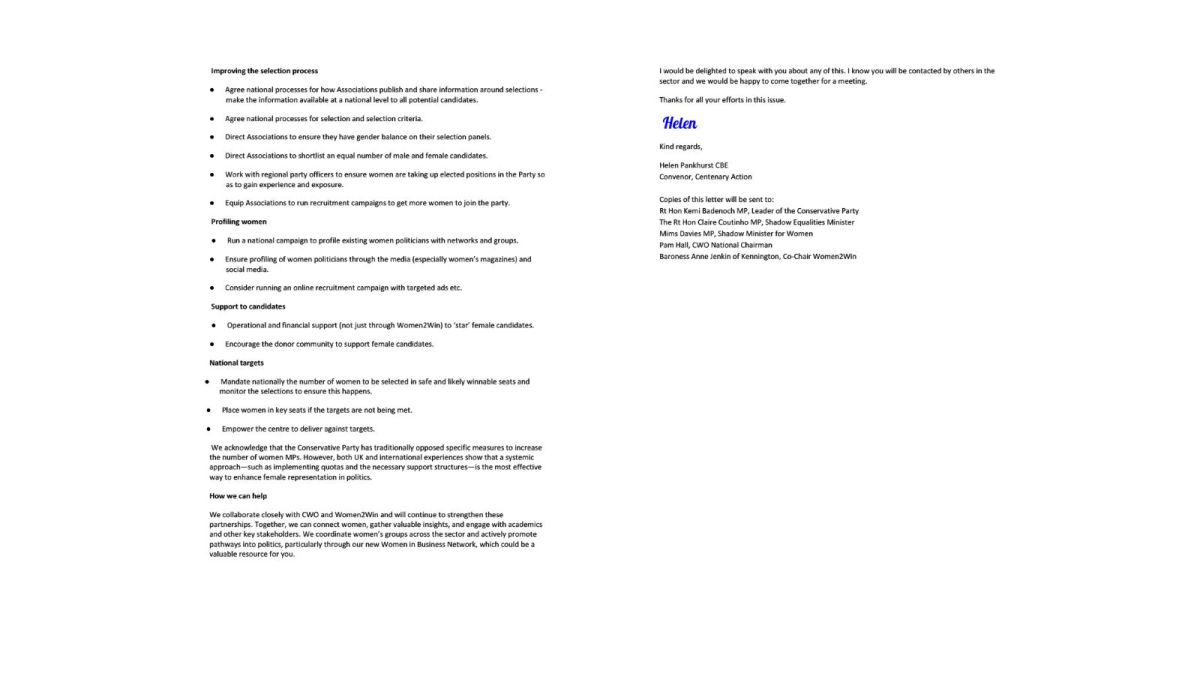
In February 2025 we wrote to the Conservative Chairmen. You can see the text of the letter below:
6 February 2025
Dear Lord Johnson and Mr Huddleston
Congratulations on being appointed Co-Chairmen of the Conservative Party. We wish you every success in the role.
Centenary Action is a coalition which works across the political landscape to campaign for a gender equal Parliament by 2028.
We are writing to you regarding your ongoing review of parliamentary candidate selection processes, to which we would like to contribute key data and insights. We have worked closely with Women2Win, CWO and through our networks have access to women seeking to stand for election. We have also spoken to academics and other stakeholders to gather data and insight. We have brought this together in this letter.
As the Party that gave us the first female Prime Minister—and three women Prime Ministers in total—we know you are committed to ensuring women are well-represented within your ranks. Additionally, the Conservative Party has endorsed the cross-party goal of achieving a gender-equal parliament by 2028. With less than four years remaining, we are working hard, alongside many of your Conservative colleagues, to make this a reality.
But, to achieve this goal and ensure more balanced political representation, we believe decisive action is needed specifically within your Party. At present, there are only 29 female Conservative MPs, representing just 24% of the Conservative group and 4% of the total number of MPs.
Data on the Conservative Party
Findings from research by Dr Chris Butler, University of Antwerp
● At the 2024 General Election 41% of candidates shortlisted for winnable seats were female, but only 28% of candidates selected in those winnable contests were female.
● Compared to the 2019 election, at the 2024 election the Conservative Party did better at shortlisting women for winnable seats, with 41% compared to 34%, but still fell short of 50:50 gender parity.
● In 2024 the proportion of women who won contests for winnable seats was lower than in 2019 (28% compared to 30%) demonstrating that women are significantly less likely to be selected from contested shortlists for Conservative selections.
● The findings demonstrate that younger women, older women and ethnic minority women are less likely to be selected even once shortlisted.
● Modelling shows that in 2024 Conservative Party selections, female shortlisted candidates were 14% less likely to be selected, controlling for ethnicity, being locally resident and having stood for election previously.
Findings from research by Professor Hilde Coffé and Dr Kaitlin Senk, University of Bath
● There are gender disparities in campaign financing and electoral outcomes among Conservative candidates.
● Whilst, in general women spend a higher proportion of their campaign spending limits than men, this is not true for Conservative candidates.
● Conservative women spent about 11% less of their spending limits and received 14% less in donations than Conservative men. On average, Conservative women received £7,617 in donations, compared to £9,604 for men.
● Conservative women were less likely to run in safe seats (31% versus 43% for men) or as incumbents (27% versus 48%). No such disparities were found among Labour candidates, where
men and women had similar chances of running in safe seats and as incumbents.
● There were no significant gender differences in the likelihood of winning a seat in the 2019 election, except for in the Conservative Party, where women were less likely to win.
● For both men and women, campaign spending and donations have a significant and positive impact on the probability of winning the election.
We would be happy to connect you with any of these academics, and other academics working on political representation, if you, or your team, would find this of use.
Action
We think you will agree that there needs to be a step change to ensure that more women are both selected and elected. Identifying and pulling the levers will be key to making that happen.
We have identified some key areas where change can be made to improve the situation of women candidates.
Sourcing the talent
● Initiatives to engage women through campaigns that highlight the impact they can have by getting involved in Conservative politics and making a difference.
● Expand talent pools by forging new connections with students, women in business/industry/professional networks and women’s organisations etc.
Supporting potential candidates
● Ensure CWO has the resources to deliver training and mentoring across all areas for potential candidates.
● Identify standout candidates and provide them with both financial and operational support to ensure their success.
Improving the selection process
● Agree national processes for how Associations publish and share information around selections – make the information available at a national level to all potential candidates.
● Agree national processes for selection and selection criteria.
● Direct Associations to ensure they have gender balance on their selection panels.
● Direct Associations to shortlist an equal number of male and female candidates.
● Work with regional party officers to ensure women are taking up elected positions in the Party so as to gain experience and exposure.
● Equip Associations to run recruitment campaigns to get more women to join the party.
Profiling women
● Run a national campaign to profile existing women politicians with networks and groups.
● Ensure profiling of women politicians through the media (especially women’s magazines) and social media.
● Consider running an online recruitment campaign with targeted ads etc.
Support to candidates
● Operational and financial support (not just through Women2Win) to ‘star’ female candidates.
● Encourage the donor community to support female candidates.
National targets
● Mandate nationally the number of women to be selected in safe and likely winnable seats and monitor the selections to ensure this happens.
● Place women in key seats if the targets are not being met.
● Empower the centre to deliver against targets.
We acknowledge that the Conservative Party has traditionally opposed specific measures to increase the number of women MPs. However, both UK and international experiences show that a systemic approach—such as implementing quotas and the necessary support structures—is the most effective way to enhance female representation in politics.
How we can help
We collaborate closely with CWO and Women2Win and will continue to strengthen these partnerships. Together, we can connect women, gather valuable insights, and engage with academics
and other key stakeholders. We coordinate women’s groups across the sector and actively promote pathways into politics, particularly through our new Women in Business Network, which could be a valuable resource for you.
I would be delighted to speak with you about any of this. I know you will be contacted by others in the sector and we would be happy to come together for a meeting.
Thanks for all your efforts in this issue.
Helen
Kind regards,
Helen Pankhurst CBE
Convenor, Centenary Action
Copies of this letter will be sent to:
Rt Hon Kemi Badenoch MP, Leader of the Conservative Party
The Rt Hon Claire Coutinho MP, Shadow Equalities Minister
Mims Davies MP, Shadow Minister for Women
Pam Hall, CWO National Chairman
Baroness Anne Jenkin of Kennington, Co-Chair Women2Win