
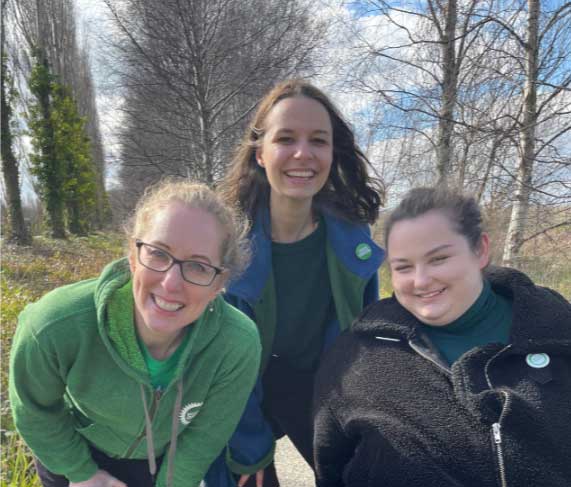
Lorna Slater, Jule Bandel and Kayleigh O’Neill (Government Minister and two Edinburgh councillors elected in 2022).
In this blog Laura Moodie, Co-Convener of the National Council of Scottish Greens, outlines the work done to transform women’s representation in the Scottish Green party.
You may have missed it but a landmark in women’s representation in politics was reached in 2021. Following a summer of negotiations, the Scottish Green Party joined the Scottish Government through a co-operation agreement.
The Scottish Greens had elected 8 MSPs in May – 5 women and 3 men, narrowly missing out on electing two further women – and thus became the first party of government in the UK to have a majority of women representatives, even with one of them rescinding her Party allegiance to become the Parliament’s speaker.
Five years earlier, the party had elected 5 men and just 1 woman; tripling our MSPs but going backwards on representation. Despite having a gender-balanced slate of leading candidates going into that election, we elected MSPs that didn’t represent the talent or potential of our women candidates.
We had a “zipped list” gender-balancing system that saw some excellent women candidates “balanced” down in favour of men. Too often women were contesting the toughest-to-win areas with little support.
The Scottish Greens realised that the simple approaches of all-women short-lists, gentle encouragement and leaving the hard work to women themselves would not make the progress we needed.
A systemic problem needed a systemic solution.
There was a rapid review; an acknowledgement of where women candidates were insufficiently supported and resourced and had not been standing in equally winnable positions. We went back to the drawing board in terms of how we select our candidates at all levels.
At the 2017 Council elections, Greens saw proportionally more women elected than any other party – 45% of our elected councillors were women. This not only reflected improved internal processes but also prioritisation; our resources and efforts focussed on seats contested by women.
At the European elections in 2019 the revised gender-balancing rules meant a woman would head the list and that 2 of the top 3 candidates should be women. This led to changed voting patterns by members: they voted for our MEP candidate list to be headed by 4 women – all selected without any gender balancing mechanisms applied.
By creating candidate positions specifically for women, we invited in talent and allowed women to gain experience as candidates. This was key to tackling the barriers women face in standing and in tipping the scales of bias that see such an over-representation of men in all levels of politics.
We found early selection of candidates enabled women to plan and build their profile and for support to be better targeted. In 2021 we had more Green women standing than ever and women topped every regional list not being contested by an incumbent.
There has also been a change in terms of the visibility of women inside the Party. Every branch and committee has at least one woman at the helm; and sometimes two, thanks to our co-leadership model. This challenges the rigid 50/50 approach which risks the perception that women need a man to help them and can exclude other marginalised genders. It also helps to share the workload and support women to take on vital roles such as chairing debates.
Our inspiring Women’s Network is supportive and inclusive and provides support for all members who identify as women or non-binary, including training, advice and a safe environment to address challenges and herald successes. At the Council elections in 2022, while half our candidates were women, including the first openly trans woman to be elected, the proportion who became councillors was only slightly higher than in 2017.
More needs to be done but we know what works, what doesn’t, and what a difference more women in leadership positions makes to politics and society.